Audio transcript The complete spoken story
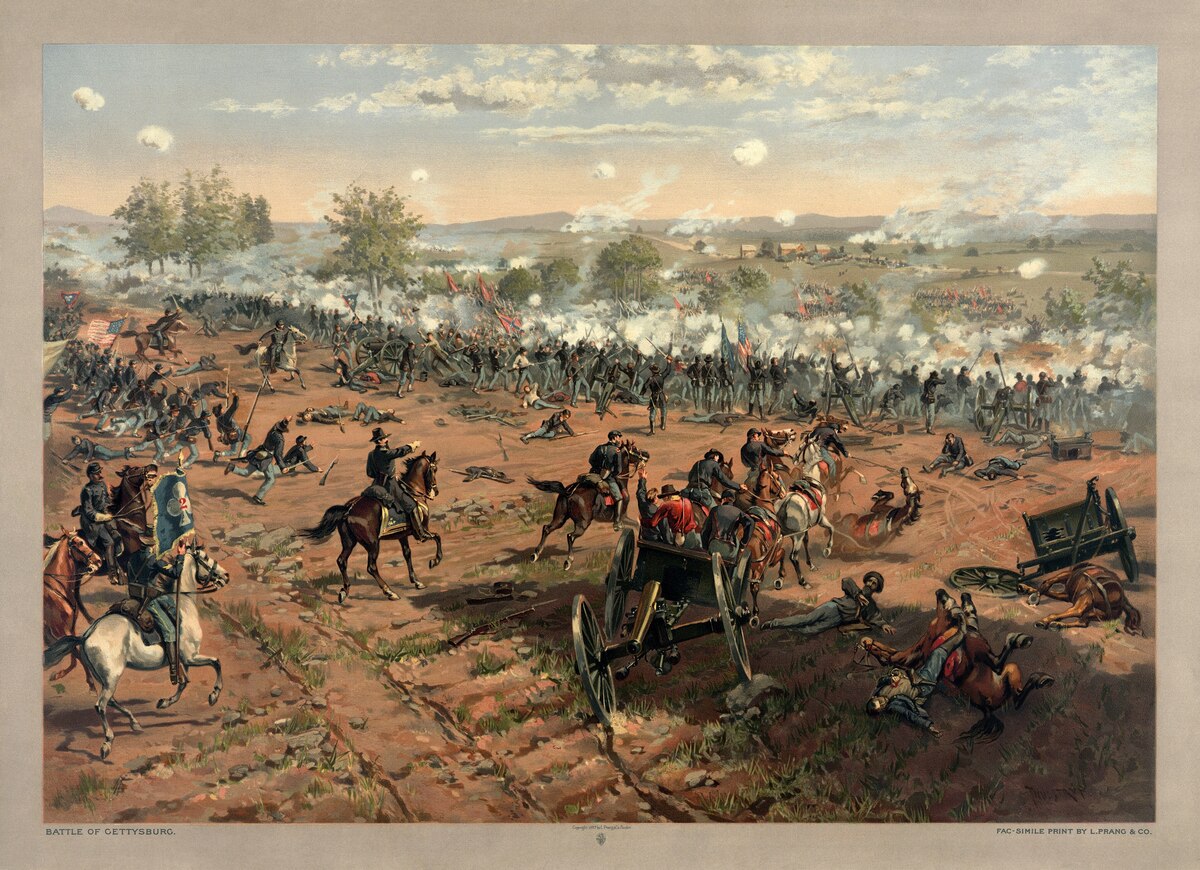
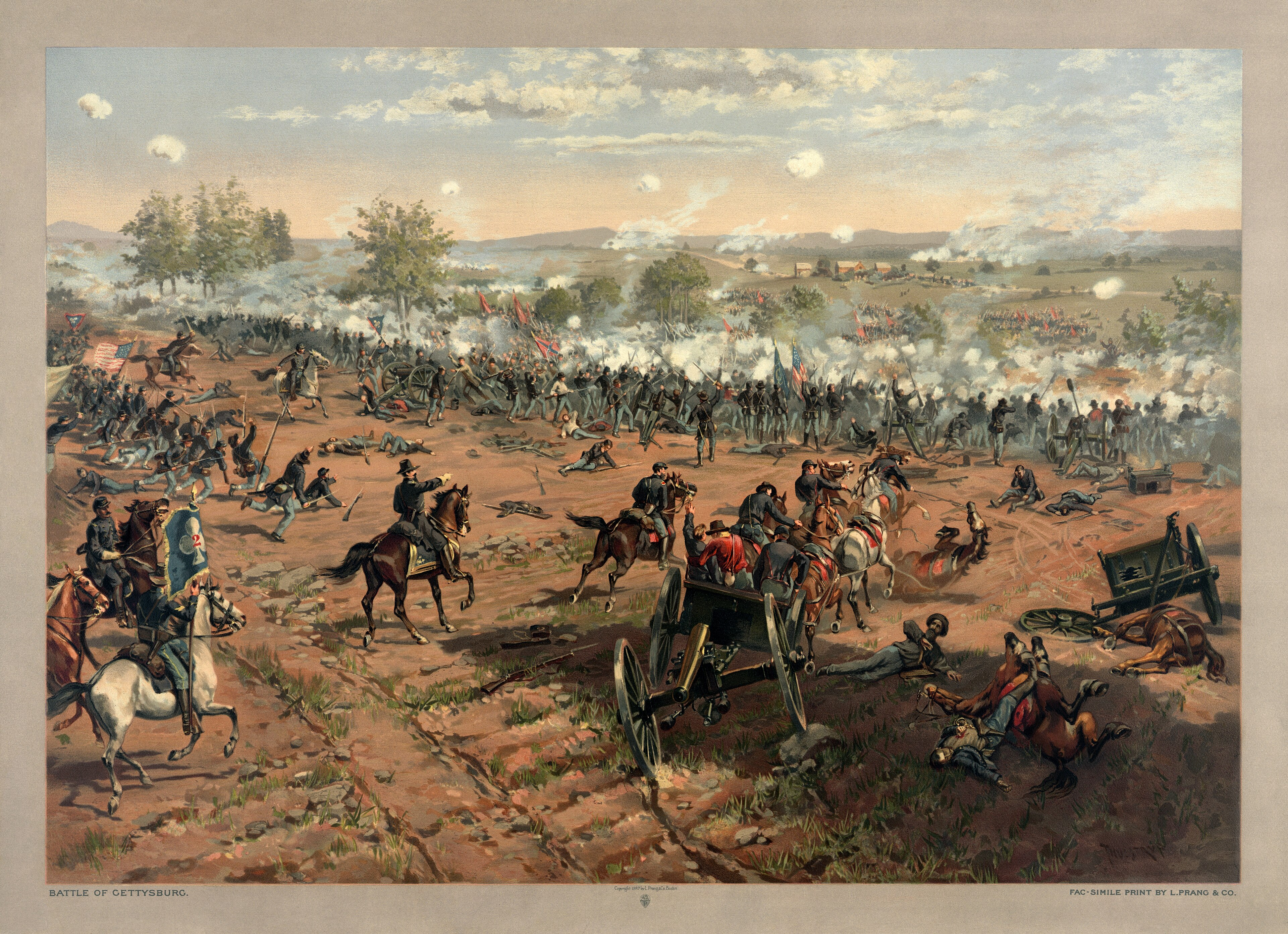
What you are looking at is Pickett's Charge at Gettysburg, rendered as a painting by Thure de Thulstrup and issued as a print by L. Prang and Company.
The charge was a Confederate assault, and the defenders in the foreground are Union troops. George Pickett led the attack; Winfield Hancock commanded the Union defense against it.
At the centre, massed Union infantry fire volleys into a bank of smoke, with United States flags and regimental colours held high above the ranks. That block of soldiers is the compositional heart of the scene.
Just behind and around them, a horse-drawn limber and caisson with dark wheels charges across churned ground, drivers in blue and red. The battery, in other words, is moving at speed through the same narrow space.
The clearest human gesture sits in the foreground: a mounted officer in a dark coat on a brown horse, his right arm thrown up as he turns. He is the image's figure of command.
The cost is rendered literally on the right, where a collapsed brown horse and sprawled casualties lie beside a shattered carriage and a loose wheel. The scene keeps loss close, not distant.
In the right distance, red battle flags and grey-clad attacking troops emerge from the powder smoke. That is the opposing assault line, shown at the moment it becomes visible through the haze.
On the lower left, a mounted figure on a white horse anchors the edge of the action, with further horsemen behind. The composition balances this left-hand counterweight against the central fire and the attackers on the right.
Pickett's Charge was a Confederate attack, and this print sets the Union response in the foreground. The defenders hold the centre while the attackers appear in the distance.
Thulstrup's painting is known as Hancock at Gettysburg, and the present object is a print of that painting issued by L. Prang and Company. The title used here, Battle of Gettysburg, is the discovery title.
One point of confusion is worth clearing up. The Library of Congress description at one time merged the two commanders into a single person, George Hancock, and the error has been reported.
Pickett was the Confederate commander who led the charge; Hancock was the Union commander who defended against it. They were two people on opposite sides, and the merged name does not describe either one.
The object in front of you is not a single untouched sheet. It is a print reproduced here through a digital restoration by Adam Cuerden.
That restoration began from a Library of Congress scan of the vellum print. Cuerden carried out a large-scale cleanup, with small tonal and photographic adjustments. The artist of the painting is Thulstrup; Cuerden is not.
Many Thulstrup prints were made on vellum. On the original surface, the scan picks up a fine dappling where the Library of Congress scanner light reflects off dimples left by hair pores.
That detail matters for what you are seeing: the texture belongs to the support and the scan, not to a painted sky or a printed fog. The digital file is a restoration of a print, not a photograph of the painting itself.
Seen together, the central volley, the rushing battery, the raised arm of command and the fallen horse on the right form one argument about the charge. This is not a portrait of a general but a picture of a line holding under pressure.
The attackers are present, but they are distant and obscured; the defenders, their flags, their guns and their casualties occupy the foreground. Thulstrup stages the charge as something endured at close range before it is seen arriving.