ArchiveBattle of Gettysburg

Artwork record / 237 of 331

Battle of Gettysburg by Thure de Thulstrup (Not dated in the supplied source)

Artist: Thure de Thulstrup

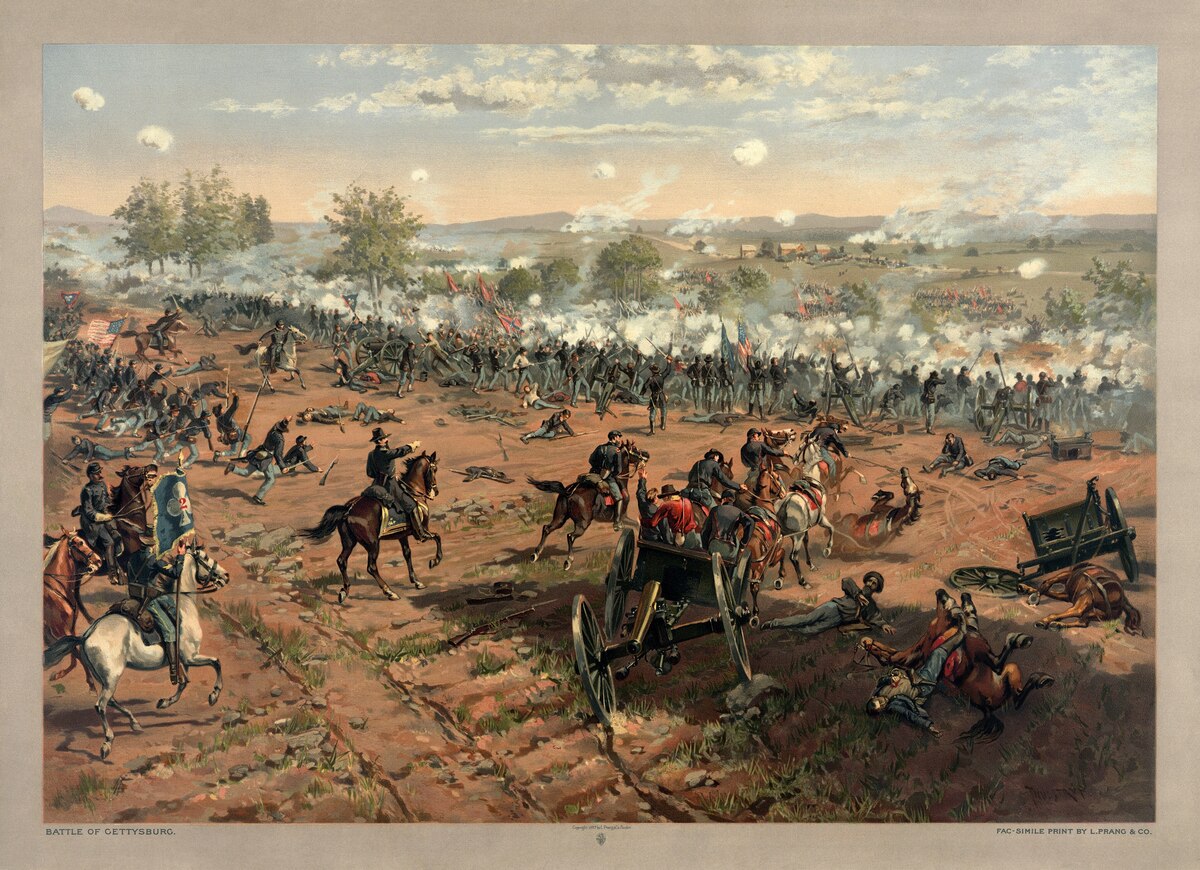
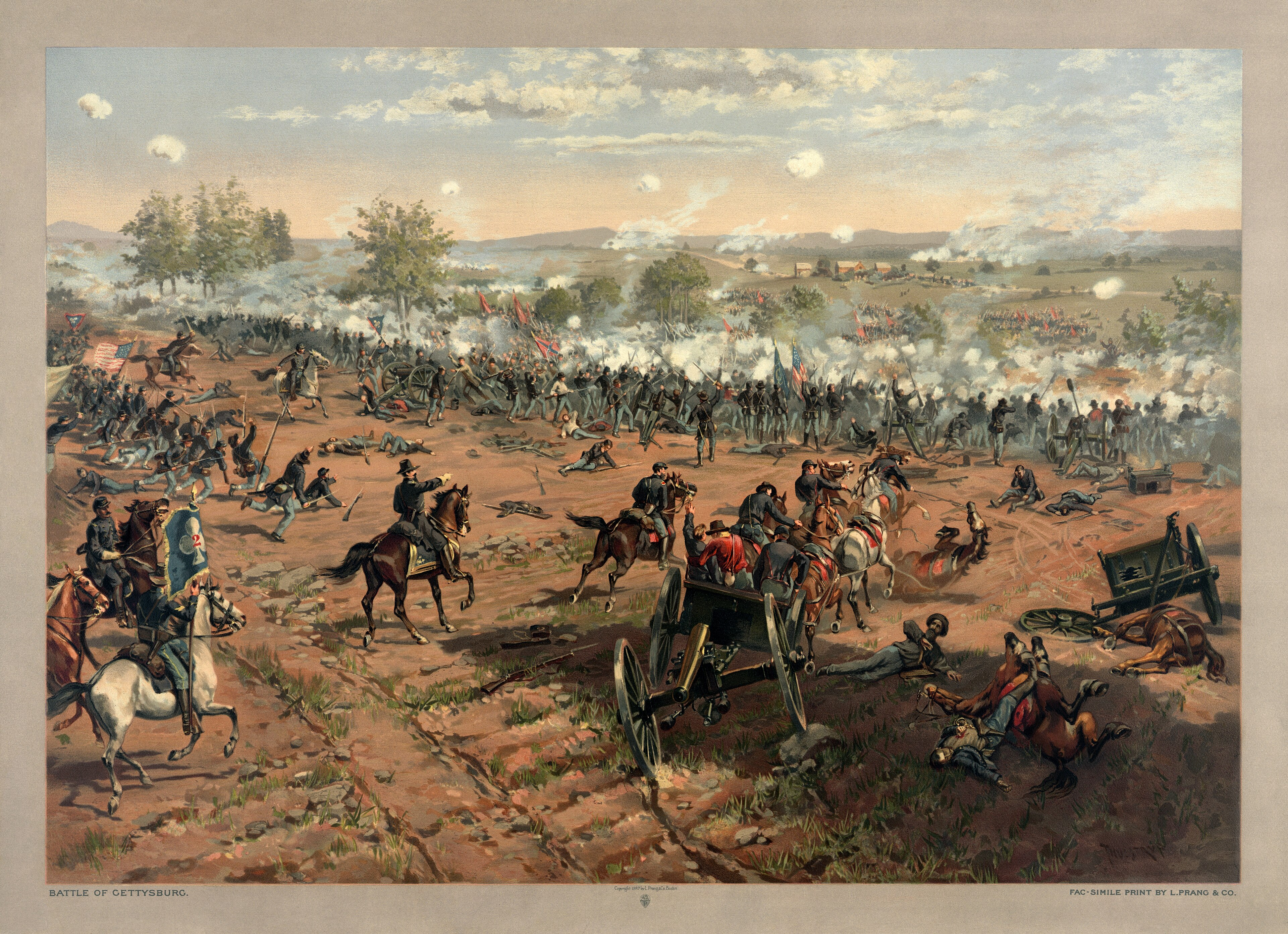
A restored L. Prang and Company print after Thure de Thulstrup's painting Hancock at Gettysburg. The scene is Pickett's Charge: massed Union infantry fire into the smoke while a mounted officer rallies the line, artillery rushes across churned ground, and Confederate battle flags show in the distance. The account distinguishes observation and curatorial reading from the disputed catalogue record and the digital restoration.

Read the story ↓ About the artist ↓ Research and record ↓ Literature and sources ↓ Listen to the article ↓
Article text for AI
Shop this artwork ↓ 5 visits
DateNot dated in the supplied sourceCultureUnited States PeriodNineteenth-century American history painting and chromolithographic printmaking
Listen to the article 4:27
100%
Battle of Gettysburg by Thure de Thulstrup (Not dated in the supplied source)
Loading full-resolution artwork…
Scroll to zoom · drag to pan · double-click to focus Pinch to zoom · drag to explore · double-tap to focus FIELD VIEW / 237
Tools & download
Pixel colour Select a pixel with the eyedropper
No pixel selected

Choose the eyedropper, then click or tap the image. Scroll to zoom for finer selection.

Add text

Hand to pan · Select to move text and drawings · Add as many texts as you like · Scroll to zoom

Battle of Gettysburg: high-resolution image

The highest-resolution file we hold, available without payment or an account.3,840 × 2,784 pixels.

Download highest-resolution image

Details to notice

About 4 minutes to read
01

Mounted trooper on white horse

A mounted figure on a white horse at the lower left foreground, with further horsemen behind, anchoring the left edge of the action and giving a near-scale figure for the battlefield.

02

Confederate advance and battle flags

Red battle flags and gray-clad attacking troops emerging from the powder smoke in the right distance, marking the opposing assault line against which the Union volleys are directed.

03

Dead horse and fallen soldiers

A collapsed brown horse and sprawled casualties beside a shattered carriage and loose wheel at the right foreground, the cost of the charge rendered in close-up.

Portrait unrecorded

About the artist

Thure de Thulstrup

1848 to 1930

Thure de Thulstrup was a Swedish-born American illustrator (1848–1930). Their recorded places of work include United States.

Born
1848
Died
1930
Nationality
United States; Sweden
Birthplace
Stockholm
Died in
New York City

The research & record

Study the work.
Follow the evidence.

Find catalogue details, historical context, technical research and the literature behind this artwork.

Article text for AI
Open research text

The artwork record

Research catalogue

Catalogue information and detailed research, with references that link to the bibliography.

Updated .

Identity and catalogue

Link
Artist or attribution
Thure de Thulstrup(Wikimedia Commons: Battle of Gettysburg, n.d.)
Object date
Not dated in the supplied source
Medium and support
Print by L. Prang and Company, after a painting by Thure de Thulstrup
Movement or period
Nineteenth-century American history painting and chromolithographic printmaking
Country or culture
United States
Depicted subject
The print reproduces Thure de Thulstrup's painting Hancock at Gettysburg, which shows Pickett's Charge. Union infantry fire into the smoke while a mounted officer rallies the line, artillery moves in the foreground, and Confederate battle flags and attacking troops appear in the distance.(Wikimedia Commons: Battle of Gettysburg, n.d.)
Title variants
Hancock at Gettysburg
Attribution qualification
Reproduced as a print by L. Prang and Company; the digital file is a restoration by Adam Cuerden, who is not the artist.
Support
Vellum, according to the supplied restoration note(Wikimedia Commons: Battle of Gettysburg, n.d.)
Dimensions
Not recorded in the supplied source
Titles and attribution

The object catalogued here is a painting titled in the supplied source as Battle of Gettysburg, a discovery title rather than the title under which the composition is otherwise known. In the same account the picture is identified as a print, issued as a reproduction of a painting by Thure de Thulstrup that L. Prang and Company printed under the title Hancock at Gettysburg. The two titles therefore designate overlapping but not identical things: Hancock at Gettysburg belongs to the painted composition and its Prang issue, while Battle of Gettysburg is the descriptive designation attached to this file at the point of discovery. The mounted figure on a white horse at the lower left foreground, with further horsemen behind, and the mounted officer in a dark coat on a brown horse whose right arm is thrown up as he turns, are the human presences given prominence in the foreground; the catalogue title does not name them.(Wikimedia Commons: Battle of Gettysburg, n.d.)

Composition and historical reading

Interpretation

Read together, the foreground detail assembled in the description forms an argument about how the charge is staged. A horse-drawn limber and caisson with dark wheels, its drivers in blue and red, charges across churned ground, giving the battery the noise and motion of the episode; a collapsed brown horse and sprawled casualties lie beside a shattered carriage and a loose wheel at the right foreground, keeping the cost of the charge in close-up rather than distant; a mounted officer in a dark coat on a brown horse throws up his right arm as he turns, the clearest human gesture of command in the picture; and a mounted figure on a white horse at the lower left anchors the edge of the action with further horsemen behind. The defenders, their flags, their guns and their casualties occupy the foreground, while the attackers remain present but distant and obscured. This is not a portrait of a general but a picture of a line holding under pressure, and the composition stages the charge as something endured at close range before it is seen arriving.(Wikimedia Commons: Battle of Gettysburg, n.d.)

The supplied source identifies the object as a painting and records the discovery title Battle of Gettysburg.(Wikimedia Commons: Battle of Gettysburg, n.d.)

The source states that L. Prang and Company printed the painting Hancock at Gettysburg by Thure de Thulstrup.(Wikimedia Commons: Battle of Gettysburg, n.d.)

Subject and iconography

Link
Composition and Foreground Action

Visual observation

The print's visual account is organized around a small number of clearly legible focal points. At the center, massed Union infantry fire volleys into banks of smoke, with United States flags and regimental colors held above the ranks; the source identifies this block of soldiers as the compositional heart of the battle scene. Behind and around that central block, a horse-drawn limber and caisson with dark wheels charges across churned ground, its drivers in blue and red, conveying the noise and motion of the battery through the same narrow space. The clearest human gesture in the foreground belongs to a mounted officer in a dark coat on a brown horse, his right arm thrown up as he turns, which the source reads as the image's figure of command. Taken together, the central volley, the moving battery, and the raised arm of the officer form a coordinated foreground argument about the Union defense under pressure.(Wikimedia Commons: Battle of Gettysburg, n.d.)

The print does not confine loss to the distance. At the right foreground, a collapsed brown horse and sprawled casualties lie beside a shattered carriage and a loose wheel, rendering the cost of the charge in close-up. On the lower left, a mounted figure on a white horse, with further horsemen behind, anchors the edge of the action and provides a left-hand counterweight to the central fire and the attackers on the right. In the right distance, red battle flags and gray-clad attacking troops emerge from the powder smoke, marking the opposing assault line as it becomes visible through the haze. The source states that the print shows Pickett's Charge, the Confederate assault named for its commander; within the terms the source establishes, George Pickett was the Confederate commander who led the charge, while Winfield Hancock was the Union commander who defended against it. The composition accordingly keeps the defenders, their flags, their guns, and their casualties in the foreground while the attackers remain present but distant and obscured.(Wikimedia Commons: Battle of Gettysburg, n.d.)

The source describes the mounted officer in a dark coat on a brown horse, his right arm thrown up as he turns, as the clearest human gesture of command in the foreground.(Wikimedia Commons: Battle of Gettysburg, n.d.)

The source describes the central massed Union infantry firing volleys into the smoke with United States flags and regimental colors held above the ranks, as the compositional heart of the battle scene.(Wikimedia Commons: Battle of Gettysburg, n.d.)

The source describes a horse-drawn limber and caisson with dark wheels and drivers in blue and red charging across churned ground, showing the noise and motion of the battery.(Wikimedia Commons: Battle of Gettysburg, n.d.)

The source describes a collapsed brown horse and sprawled casualties beside a shattered carriage and loose wheel at the right foreground, rendering the cost of the charge in close-up.(Wikimedia Commons: Battle of Gettysburg, n.d.)

The source describes red battle flags and gray-clad attacking troops emerging from the powder smoke in the right distance, marking the opposing assault line.(Wikimedia Commons: Battle of Gettysburg, n.d.)

The source describes a mounted figure on a white horse at the lower left foreground, with further horsemen behind, anchoring the left edge of the action.(Wikimedia Commons: Battle of Gettysburg, n.d.)

Historical context

Link
Identification and commission circumstances

The object is a print of the painting Hancock at Gettysburg by Thure de Thulstrup, issued by L. Prang and Company, and the picture depicts Pickett's Charge at Gettysburg. The source records the discovery title Battle of Gettysburg separately from the painting's known title, so the archive distinguishes the descriptive title attached to the file page from the title under which the painted composition is known. The same source identifies the depicted episode as Pickett's Charge, fixing the subject that the rest of the visual evidence elaborates.(Wikimedia Commons: Battle of Gettysburg, n.d.)

Visual observation

The source states that George Pickett was a Confederate commander who led the charge, and that Winfield Hancock was a Union commander who defended against it. The print's title, Hancock at Gettysburg, names the Union defender rather than the attacking commander, and the source's account of the composition places the massed Union infantry at the compositional heart of the battle scene, with United States flags and regimental colors held above the ranks; the attackers appear only in the right distance, emerging from powder smoke as red battle flags and gray-clad troops. Title, subject and compositional emphasis therefore agree that the picture is organized around the defense, even though the event it depicts is named for the assault.(Wikimedia Commons: Battle of Gettysburg, n.d.)

The Library of Congress description at one time merged the two commanders into one person, George Hancock, and the source reports that the error has been reported. This matters for the object's documentation rather than for its form: the catalogue error conflated two opponents who stood on opposite sides at Gettysburg, and the correction separates Pickett, who led the charge, from Hancock, who defended against it. The archive treats the institutional description as a source that required correction and the source's account of the two commanders as the basis for that correction, without treating the file page as a full commissioning document.(Wikimedia Commons: Battle of Gettysburg, n.d.)

The source states that the print shows Pickett's Charge.(Wikimedia Commons: Battle of Gettysburg, n.d.)

The source states that George Pickett was a Confederate commander who led the charge, and that Winfield Hancock was a Union commander who defended against it.(Wikimedia Commons: Battle of Gettysburg, n.d.)

Materials and technique

Link
Object and source identification

The object under study is a print of Thure de Thulstrup's painting Hancock at Gettysburg, issued by L. Prang and Company and catalogued on the Wikimedia Commons file page under the discovery title Battle of Gettysburg. The source identifies the picture as a painting and states that L. Prang and Company printed the painting Hancock at Gettysburg by Thure de Thulstrup, with the print showing Pickett's Charge. The source records that the image is in the public domain. These identifications are supplied by the source's description rather than by exact institutional evidence, and the annotation explicitly notes that the description does not override institutional evidence, so the attribution of artist and publisher should be understood as a source-supplied identification of the object presented here.(Wikimedia Commons: Battle of Gettysburg, n.d.)

Support and surface of the print

The source states that the print, like many Thulstrup prints, was done on vellum. It further states that the surface dappling of the vellum appears when the Library of Congress scanner light reflects off the dimples from hair pores. This is a statement about the support and about how the scan registers it, not a description of painted or printed content. The source distinguishes the texture of the support from a painted sky or a printed fog, which means the dappling visible in the digital file belongs to the material of the print and to the scanning process, not to the imagery itself.(Wikimedia Commons: Battle of Gettysburg, n.d.)

Restoration and imaging chain

The source states that the image was restored by Adam Cuerden, who performed a large-scale cleanup and small tonal and photographic adjustments to the Library of Congress scan of the vellum print. The original scan was made by the Library of Congress. Cuerden's work is therefore a digital restoration of a scan of the print, and the source is explicit that the digital file is a restoration of a print, not a photograph of the painting itself. The artist of the painting is Thulstrup; Cuerden is not the painter. The restoration thus sits between the physical vellum print and the image now under examination.(Wikimedia Commons: Battle of Gettysburg, n.d.)

What can be seen and where

Visual observation

The source describes the mounted officer in a dark coat on a brown horse, his right arm thrown up as he turns, as the clearest human gesture of command in the foreground. It also describes a mounted figure on a white horse at the lower left foreground, with further horsemen behind, anchoring the left edge of the action. Both descriptions are observations of the image rather than technical findings about its making, and they are relevant here because they indicate where the restoration and the support surface are being examined: the foreground figures occupy the areas where tonal adjustments and vellum texture are most likely to be visible.(Wikimedia Commons: Battle of Gettysburg, n.d.)

A reported catalogue error

The source reports a catalogue problem that bears on how the object has been described: the Library of Congress description mistakenly combined George Pickett and Winfield Hancock into one person, George Hancock, and the error has been reported. The source states that George Pickett was a Confederate commander who led the charge and that Winfield Hancock was a Union commander who defended against it. The print itself shows Pickett's Charge and is a print of the painting Hancock at Gettysburg, so the merged name does not describe either commander and does not match the object's documented subject.(Wikimedia Commons: Battle of Gettysburg, n.d.)

Evidence and its limits

Interpretation

Read together, the technical statements and the visual descriptions define the limits of what the available evidence establishes about this object. The evidence establishes that the print was made on vellum, that its surface dappling comes from hair pores as registered under the Library of Congress scanner light, that the Library of Congress made the original scan, and that Adam Cuerden carried out a large-scale cleanup with small tonal and photographic adjustments. The evidence also establishes what the scene depicts as described by the source. It does not establish pigments, printing inks, plate or stone preparation, layered printing sequence, tools or press technique, and nothing in the supplied units documents treatments, exhibitions or a provenance chain. Distinguishing these categories matters because the dappling and the restoration adjustments are technical facts about the support and the file, while the flags, smoke, battery and casualties are visual observations of depicted content that should not be mistaken for material analysis.(Wikimedia Commons: Battle of Gettysburg, n.d.)

The source states that the print, like many Thulstrup prints, was done on vellum, whose surface dappling appears when the Library of Congress scanner light reflects off the dimples from hair pores.(Wikimedia Commons: Battle of Gettysburg, n.d.)

Condition and conservation

Link
Restoration of the scan

The object described here is a Library of Congress scan of a vellum print after Thure de Thulstrup's painting Hancock at Gettysburg, published by L. Prang and Company. Condition and conservation records for it begin with the scan itself rather than with an examination of the sheet: the image was restored by Adam Cuerden, who performed a large-scale cleanup and small tonal and photographic adjustments to the Library of Congress scan of the vellum print. The restoration credit is therefore a claim about the digital file, not about the physical impression, and the two things should not be conflated. The print is the work of Thulstrup and of L. Prang and Company; Cuerden's role is that of restorer of the scan, and the source is explicit that he is not the artist.(Wikimedia Commons: Battle of Gettysburg, n.d.)

Interpretation

The evidence supplied here records no dated condition survey, no examination report, no measurement of losses, tears, foxing or fading, no treatment proposal, no conservation materials, no environmental or storage measures and no exhibition history for the physical print. What it does record is a specific restoration method applied to a digital surrogate: a large-scale cleanup followed by small tonal and photographic adjustments. Read conservatively, the file documents a digital intervention and the source of its starting image; it does not establish the current physical condition of the vellum print, and no observation from that scan should be treated as a description of the object's present state. The reported catalogue error at the Library of Congress, in which George Pickett and Winfield Hancock were merged into a single person named George Hancock and the mistake has been reported, is a separate matter of documentation, but it shows that metadata attached to this object has been corrected in the past and may not be self-verifying.(Wikimedia Commons: Battle of Gettysburg, n.d.)

The source states that the image was restored by Adam Cuerden, who performed a large-scale cleanup and small tonal and photographic adjustments to the Library of Congress scan of the vellum print.(Wikimedia Commons: Battle of Gettysburg, n.d.)

Provenance and ownership

Link
Documented Object and Its Reproduction Chain

The supplied record identifies this object as a print, reproduced here through a digital restoration, of a painting by Thure de Thulstrup issued by L. Prang and Company. The discovery title attached to the file is Battle of Gettysburg, while the painting itself is known as Hancock at Gettysburg; the discovery title and the painting title are not the same thing, and the source supplies both without collapsing them. The source states that the print shows Pickett's Charge. The Library of Congress is recorded as the maker of the original scan from which the present digital file descends, and the source records that the image is in the public domain, with its license status given as public domain. No ownership chain, sale, accession number or date of transfer is supplied anywhere in the available evidence; the provenance that can be documented here concerns the object's photographic and digital reproduction history rather than a sequence of private or institutional owners.(Wikimedia Commons: Battle of Gettysburg, n.d.)

The reproduction chain is the only documented chain of custody in this evidence. A Library of Congress scan was made from the vellum print; Adam Cuerden then carried out a restoration that began from that scan, comprising a large-scale cleanup together with small tonal and photographic adjustments. The present digital file is therefore a restoration of a print, not a photograph of the painting itself, a distinction the source makes explicitly. The source also notes that the artist of the painting is Thulstrup, and that Cuerden is not the artist, separating the nineteenth-century creation of the image from the modern digital intervention that produced the file now consulted. The original scan is attributed to the Library of Congress, and the restoration is attributed to Cuerden, so two distinct acts of mediation stand between the painting and the viewer.(Wikimedia Commons: Battle of Gettysburg, n.d.)

The source identifies the support in specific terms: the print, like many Thulstrup prints, was done on vellum, and the surface dappling visible in the scan appears when the Library of Congress scanner light reflects off the dimples left by hair pores. That observation locates the texture in the material support and in the act of scanning rather than in painted sky or printed fog. Read as provenance evidence, this detail qualifies how the object can be known at all: what the file preserves is a particular vellum impression as registered by a particular scanner, after Cuerden's cleanup and adjustments. It does not record a change of ownership, and nothing in the evidence states when the print was made, when it was acquired, or who held it before or after the scan.(Wikimedia Commons: Battle of Gettysburg, n.d.)

A Documented Catalogue Error

One documented catalogue problem bears directly on how the object has been described. The source reports that the Library of Congress description mistakenly combined George Pickett and Winfield Hancock into a single person, George Hancock, and that the error has been reported. The same source states that Pickett was a Confederate commander who led the charge, while Hancock was a Union commander who defended against it, so the merged name describes neither man and misstates the relationship between the two sides. Because the source presents this as a reported error that has been reported onward rather than as settled, the correction should be treated as an attributed account of a catalogue fault, not as an independent institutional confirmation. The misidentification is consequential for provenance in the narrow sense that it distorts the record of whose likeness the print has been taken to carry.(Wikimedia Commons: Battle of Gettysburg, n.d.)

The source states that the original scan was made by the Library of Congress.(Wikimedia Commons: Battle of Gettysburg, n.d.)

Reception and literature

Link
The print and its protagonists

The source records that the image sits in the public domain and that its license status is public domain. That legal status concerns the reproduction and reuse of the image, and it stands apart from the physical and historical facts about the print itself, which the rest of this account addresses. The public-domain designation is what has allowed the image to circulate freely in the form in which it is now encountered.(Wikimedia Commons: Battle of Gettysburg, n.d.)

Visual evidence and the staging of the charge

Interpretation

What the evidence collectively supports is a picture in which the defenders occupy the foreground, their flags, guns and casualties held close, while the attacking line appears smaller and obscured in the smoke. The visual programme and the print's circulation as a public-domain image can be understood together: a staged scene of a line holding under pressure, issued by a commercial publisher and later made freely reproducible, has passed into a form of common visual property. That is an interpretive reading of the described composition and the recorded license status, and it does not displace the attribution of the painting to Thulstrup or the print to L. Prang and Company.(Wikimedia Commons: Battle of Gettysburg, n.d.)

The source records that the image is in the public domain and its license status is public domain.(Wikimedia Commons: Battle of Gettysburg, n.d.)

Interpretations and debates

Link
The object and its multiple names

Disputed account

The object is a print issued by L. Prang and Company after a painting by Thure de Thulstrup, and it carries more than one title in the records that describe it. The painting itself is known as Hancock at Gettysburg, so the print is a reproductive rendering of that painting rather than a picture that was separately composed as a print. The discovery source that supplies the object type, artist and publisher records the title Battle of Gettysburg for this image. The subject the print depicts is Pickett's Charge, the Confederate assault at Gettysburg. These are not competing descriptions of different things: they are a known title for the painting, a discovery title for the image, and a description of the episode shown. The print is also recorded as being in the public domain, with a public domain license status, which concerns the rights in the image rather than its authorship or its history of making. The attribution of the painting to Thulstrup and the printing to L. Prang and Company stands alongside that title and rights information, so the object can be described at once as a Thulstrup composition, a Prang publication, and a scene of the charge.(Wikimedia Commons: Battle of Gettysburg, n.d.)

The source distinguishes between the two commanders whose names and roles the image brings together. George Pickett was a Confederate commander who led the charge, while Winfield Hancock was a Union commander who defended against it. The distinction matters for reading the print, because the defenders occupy the foreground while the attackers appear in the distance, so the two generals belong to opposite sides and opposite ends of the action. The same source reports a cataloguing error: the Library of Congress description mistakenly combined George Pickett and Winfield Hancock into a single person, George Hancock, and the error has been reported. The reported error concerns the description attached to the object, not the object itself, and the source does not indicate that the printed image ever carried a merged name. The evidence therefore supports describing the error as a cataloguing problem that has been noticed and reported, rather than as a fact about the picture or its publication. The source's annotation adds that its description does not override exact institutional evidence, which is a caution about how much weight the discovery account should carry against an institution's own record.(Wikimedia Commons: Battle of Gettysburg, n.d.)

The print as it survives is not a single untouched sheet in the form in which it is encountered here. The image was restored by Adam Cuerden, who performed a large-scale cleanup and small tonal and photographic adjustments. Cuerden worked from a Library of Congress scan of the vellum print, and the original scan was made by the Library of Congress. The artist of the painting is Thulstrup; Cuerden is not the artist. The source states that many Thulstrup prints were done on vellum, and that the surface dappling of vellum appears when the Library of Congress scanner light reflects off the dimples left by hair pores. That detail matters for what a viewer sees: the texture belongs to the support and to the scan, not to a painted sky or a printed fog. The digital file is a restoration of a print, not a photograph of the painting itself, so the appearance of the image here reflects a chain that runs from Thulstrup's painting through Prang's vellum print, the Library of Congress scan, and Cuerden's restoration adjustments. The discovery source records that the restoration and the scan are documented as part of the object's description, and it records the public domain status separately from that technical history.(Wikimedia Commons: Battle of Gettysburg, n.d.)

The source reports that the Library of Congress description mistakenly combined George Pickett and Winfield Hancock into one person, George Hancock, and that the error has been reported.(Wikimedia Commons: Battle of Gettysburg, n.d.)

Documented values and qualified estimates

Link
Recorded values

Interpretation

The object under discussion carries a calculated working insurance estimate of US$500 to US$2,000, recorded as a working calculation generated on 2026-10-16. The methodology describes this as a broad, conservative range prepared for manual review only, and it identifies the confirmed context on which the range rests: a nineteenth-century American chromolithographic print by L. Prang and Company after a painting by Thure de Thulstrup, titled Battle of Gettysburg and also known as Hancock at Gettysburg. The print belongs to a well-documented but not rare edition, and many impressions are held in public collections. The same methodology notes that the supplied source identifies the file as a digital restoration by Adam Cuerden rather than an original painting, and it records that no dimensions, impression date, condition report, provenance, or ownership history are available. The range is said to reflect the typically low market value of such prints when sold individually, while allowing for the possibility of a fine or rare impression, and it does not rely on comparable sales or insurance records. The accompanying qualification is explicit that this is a model-generated working range for manual review, not an official insurance value, appraisal, auction result, or sale price, that it is not based on private insurance records or comparable sales, and that actual value can vary widely with the specific impression, condition, provenance, and current market, so a qualified appraiser or insurance professional should be consulted for an official valuation. Taken on its own terms, the calculation is a conditional estimate tied to a stated object identification and a stated absence of documentation, not a market finding.(Wikimedia Commons: Battle of Gettysburg, n.d.)

Working estimate

Calculated working insurance estimate, not a sale price: Estimated insurance range: US$500 to US$2,000 Recorded date: Working calculation, generated 2026-10-16. Methodology: This is a broad, conservative working range for manual review only. It is based on the confirmed context: a 19th-century American chromolithographic print by L. Prang and Company after a painting by Thure de Thulstrup, titled Battle of Gettysburg (also known as Hancock at Gettysburg). The print is part of a well-documented but not rare edition, with many impressions held in public collections. The supplied source identifies the file as a digital restoration by Adam Cuerden, not an original painting. No dimensions, impression date, condition report, provenance, or ownership history are recorded. The range reflects the typical low market value of such prints when sold individually, while allowing for the possibility of a fine or rare impression. It does not rely on comparable sales or insurance records. Qualification: This is a model-generated working range for manual review. It is not an official insurance value, appraisal, auction result, or sale price. It is not based on private insurance records or comparable sales. The actual value of the print can vary widely depending on the specific impression, condition, provenance, and current market. Consult a qualified appraiser or insurance professional for an official valuation.(Wikimedia Commons: Battle of Gettysburg, n.d.)

Bibliography

Sources and further reading

References are arranged by author or organisation, with links to the original publications. Where no publication date is recorded, n.d. means no date.

Source notes updated .

  1. 01

    Secondary · About this artwork

    Wikimedia Commons: Battle of Gettysburg (n.d.). Wikimedia Commons file page for Thure de Thulstrup, L. Prang and Co., Battle of Gettysburg, restoration by Adam Cuerden. Wikimedia Commons.

    Discovery source that supplies the discovery title, object type, artist, publisher, depicted episode, support, original scan source, restoration credits and a reported catalogue error. Its description does not override exact institutional evidence.

    Language
    English
    Link to reference
    Citation text

Article text and sources · Reading and attribution

An unhandled error has occurred. Reload 🗙