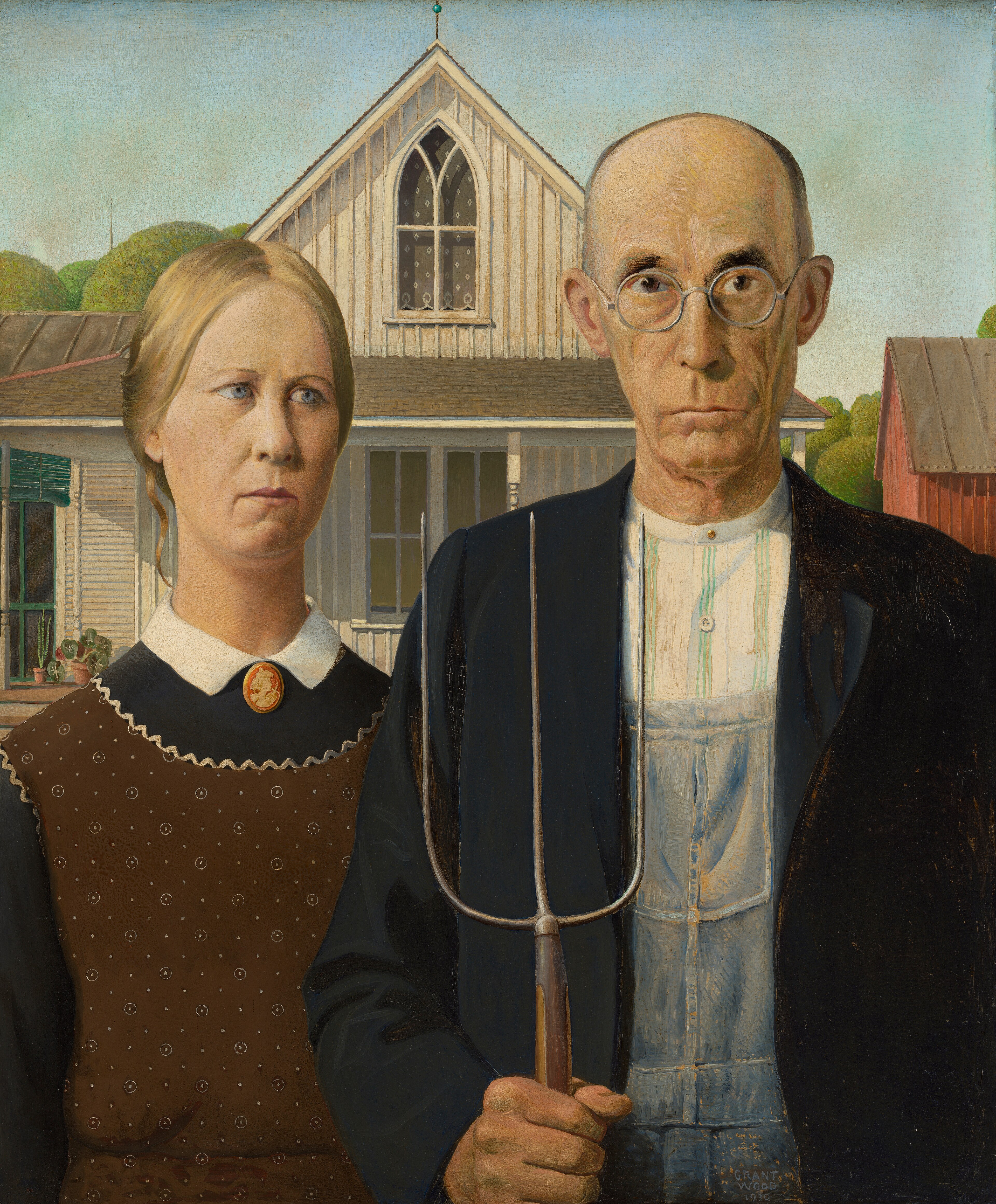
A docent-led reading of Grant Wood's American Gothic: the farmer and his daughter, the Carpenter Gothic house, the painting's reception in 1930, and the tension between Wood's stated intent and the satire many viewers saw. This draft distinguishes observation, sourced interpretation, and documented history using the Art Institute of Chicago object record.
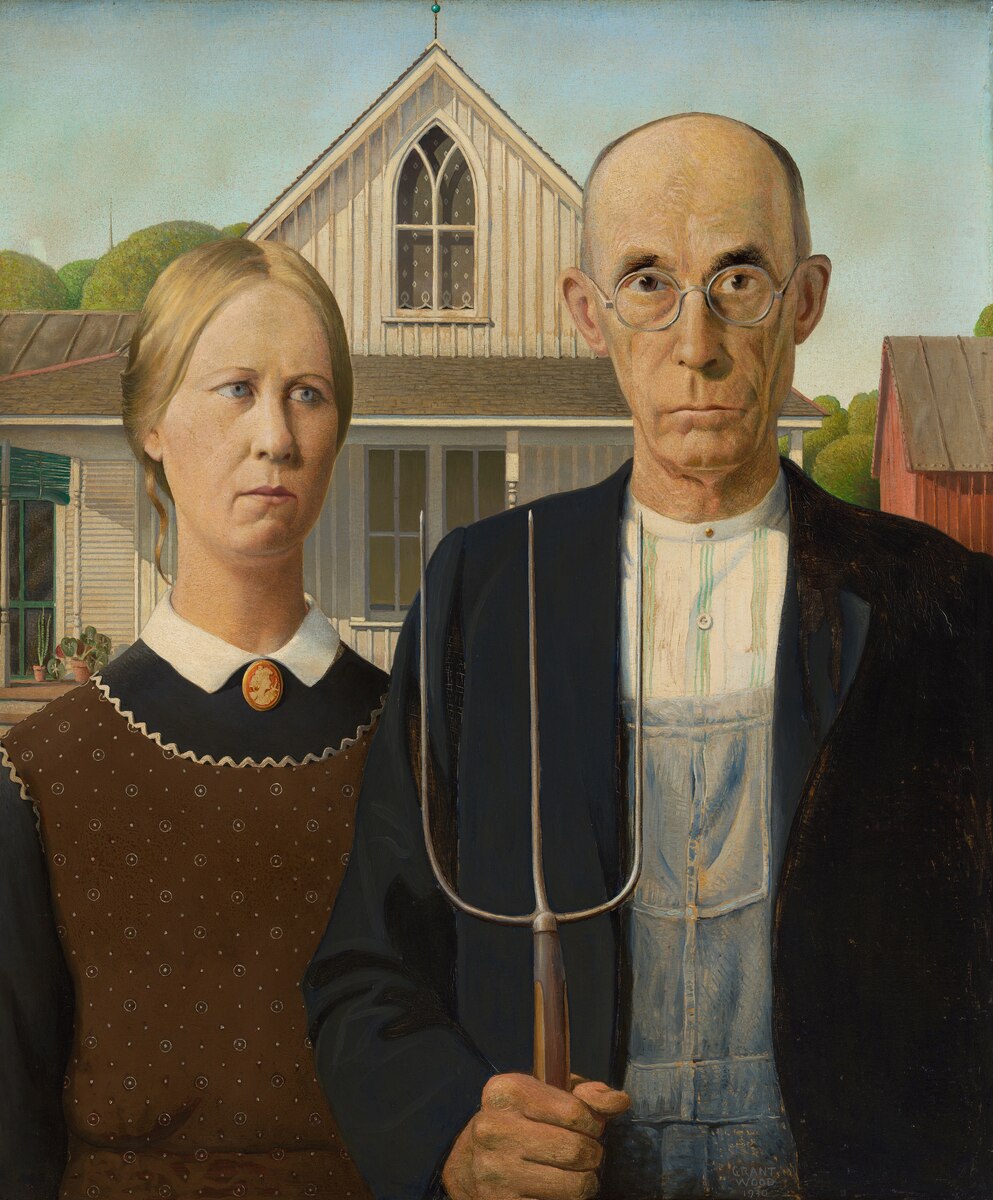
The pointed Gothic-arch window in the farmhouse gable, the Carpenter Gothic detail that gives the painting its name and its mock-solemn tone.
02
Cameo brooch on white collar
The oval cameo pinned at the woman's throat against her white collar and brown dotted dress, the small ornament that fixes her period respectability.
03
Woman's face and expression
The woman's head, hair drawn back with a stray curl, her averted, tight-lipped expression setting her apart from the man's direct gaze.
Your gallery guide
American Gothic by Grant Wood (1930)
A docent-led reading of Grant Wood's American Gothic: the farmer and his daughter, the Carpenter Gothic house, the painting's reception in 1930, and the tension between Wood's stated intent and the satire many viewers saw. This draft distinguishes observation, sourced interpretation, and documented history using the Art Institute of Chicago object record.
Editorial review by Artifact Archive automated publishing
Grant Wood's American Gothic shows a farmer and his daughter standing outside their home. The house is built in an 1880s style known as Carpenter Gothic.
The two figures are posed stiffly, dressed as if they were, in Wood's words, tintypes from my old family album. That phrase comes from the Art Institute of Chicago's object record.
The painting was made in 1930, and it became an instant sensation when it was exhibited that same year.
Look first at the vertical hold of the composition. The man's pitchfork repeats the upright lines of the house, and his overalls carry the artist's signature in light blue paint.
He stands slightly forward, facing us directly. The woman stands just behind his shoulder, her gaze turned away, her hair pulled back tightly.
The house rises between and behind them, its pointed Gothic window answering the fork's tines in shape and rhythm.
Wood had seen a similar farmhouse during a visit to Eldon, Iowa. That house, not this exact one, gave him the architectural idea for the painting.
He painted the figures as if they belonged to an older photographic tradition. The comparison to tintypes places them in a remembered family album rather than in a modern moment.
By 1930 the Great Depression was underway, and rural life was under pressure across the Midwest.
When the painting was exhibited at the Art Institute in 1930, its ambiguity prompted viewers to speculate about the figures and their story.
Many understood it as a satirical comment on midwesterners out of step with a modernizing world. That reading turns the stiff poses and severe faces into social criticism.
Wood said he intended a positive image of rural American values, offering reassurance at the beginning of the Depression. The two readings pull in different directions, and both are part of the work's history.
What holds the painting together is that tension. The careful symmetry and the plain, frontal address give the figures dignity.
At the same time, their stiffness and the isolation of the house make them feel guarded, even strange. Whether you see endurance or satire depends on which signal you follow.
American Gothic endures because it lets both readings stand. It is a portrait of a place and a mood, not a simple answer.
The story and its sources
Editorial review by Artifact Archive automated publishing.
Historical claims are linked to the records below. Close looking and interpretation are identified in the passage notes.
Grant Wood was an American painter (1891–1942). Their work is associated with Regionalism. Their recorded places of work include Minneapolis–Saint Paul; Cedar Rapids; Chicago; Iowa City; Paris.
A farmer and his daughter stand stiffly outside their home, a farmhouse built in the 1880s Carpenter Gothic style, posed as if they were tintypes from an old family album.(Art Institute of Chicago, n.d.)
The Art Institute of Chicago records the work as an oil painting on Beaver Board made by Grant Wood in 1930, and its catalogue dimensions are 78 x 65.3 cm (30 3/4 x 25 3/4 in.). The support description is specific to this object and distinguishes its material character from canvas paintings of the same period. The recorded date of 1930 belongs to the year of execution, and the museum states that it was exhibited at the Art Institute in 1930. That same year, the artist sold it to the Friends of American Art, which gave it to the Art Institute of Chicago, and it carries the credit line Friends of American Art Collection. These details establish a tight sequence in the object's early history: creation, exhibition, sale and donation occurred within a single year, and the painting entered the museum as a gift from a donor group rather than by direct purchase or bequest. The work is on view in Gallery 263, Arts of the Americas.(Art Institute of Chicago, n.d., Dimensions; Inscriptions; Provenance; About this artwork)(Wikimedia Commons, n.d., Depicted people)
The painting is signed and dated recto, bottom-right, on the overalls, in light blue paint, with the text "GRANT / WOOD / 1930". The position of the signature is itself an inscription on a depicted garment rather than an unobtrusive mark on the background, and the light blue lettering is legible against the dark fabric of the overalls. The inscription supplies the artist's name and the date 1930 in a single statement. The Art Institute of Chicago's object record also identifies the depicted figures as Nan Wood Graham and Byron H. McKeeby. Their names are recorded as the people represented in the painting, and they are the two figures catalogued in association with this work. This is the extent of the identifying information supplied by the evidence, and it does not establish their occupations, relationship to one another, or the circumstances of the sittings; those are not documented in the units supplied here.(Art Institute of Chicago, n.d., Inscriptions)(Wikimedia Commons, n.d., Depicted people)
The painting shows a farmer and his daughter posed stiffly outside their home, dressed as if they were, as the artist put it, "tintypes from my old family album." They stand before a farmhouse built in an 1880s style known as Carpenter Gothic, a nineteenth-century American domestic idiom that applied Gothic Revival pointed arches and steep gables to ordinary timber houses. Wood had seen a similar farmhouse during a visit to Eldon, Iowa; that house, and not this exact one, supplied the architectural idea. The distinction matters for how the visible building is described: the Carpenter Gothic house in the painting is a composed element of the image whose immediate model was an observed Iowa farmhouse, and the figures are presented as if they belonged to an older photographic tradition rather than to a modern moment. The comparison to tintypes, which comes from Wood himself as reported by the Art Institute of Chicago, locates the sitters in a remembered family album, and it is a statement about pictorial intention in the staging of the figures, not an identification of the real people depicted.(Art Institute of Chicago, n.d., About this artwork)
Reception and interpretation
Interpretation
Taken together, the evidence supports a qualified synthesis rather than a single settled reading. The picture is a carefully staged construction: an Iowa farmhouse type observed by the artist in Eldon reworked into the Carpenter Gothic house that rises between and behind two figures whose dress is compared by the artist to tintypes, and whose placement outside their home establishes the domestic setting the museum record describes. Two identifications of the figures' meaning circulate in the documented accounts, the satirical comment on midwesterners out of step with a modernizing world and the artist's own stated intention of a positive image of rural American values offering reassurance at the beginning of the Great Depression. Because the museum record attributes both and resolves neither, the painting's significance for the history of American art and material culture lies partly in this double address: it is at once a specific 1930 oil painting on Beaver Board with a dated inscription on the overalls, and a national icon whose ambiguity, noted from its first showing, has been examined in the museum's own scholarly publication history.(Art Institute of Chicago, n.d., Medium; About this artwork; Publication History)
Visual observation
The figures stand outside their home, a farmhouse built in an 1880s style known as Carpenter Gothic.(Art Institute of Chicago, n.d.)
The commission or creation history documented here is narrower than the painting's fame. The object record states only that Wood had seen a similar farmhouse during a visit to Eldon, Iowa. That statement establishes a documented encounter with a comparable building in Eldon; it does not identify the Eldon house as the actual house depicted, nor does it name a patron, commission, or specific date of the visit. The identification of the figures as a farmer and his daughter and of the dwelling as a Carpenter Gothic farmhouse comes from the museum's own description, not from a contract or contemporary commission document. The secure identification of the subject and its architectural source, in other words, need not settle the circumstances under which the picture was commissioned or made; the record supports the Eldon connection as an architectural pretext while leaving the commissioning history outside what these units establish.(Art Institute of Chicago, n.d., About this artwork)
American Gothic is an oil painting on Beaver Board made by Grant Wood in 1930, as recorded in the Art Institute of Chicago's object record for the work. The same record gives the painting's dimensions as 78 × 65.3 cm (30 3/4 × 25 3/4 in.). These are the material facts the museum documentation establishes: a twentieth-century American oil painting executed not on canvas or panel in the traditional sense but on Beaver Board, a manufactured wood-fiber board. The museum record also documents the inscription itself, which is painted recto at the bottom-right on the figure's overalls in light blue paint, reading "GRANT / WOOD / 1930". Because the signature and date sit on the overalls rather than on a neutral ground, the inscription is integrated into the painted image rather than added as a separate mark, and the light blue paint of the lettering is distinct from the painted surface of the overalls beneath it.(Art Institute of Chicago, n.d., Medium)
The support, Beaver Board, is a wood-fiber board rather than a stretched fabric, and the museum's object record states the medium as oil on that support without further describing preparatory layers, grounds, brushwork or any conservation treatment. Nothing in the supplied evidence establishes a specific pigment beyond the light blue paint of the signature, a specific varnish, a priming layer, or any later intervention. The account of materials and technique therefore rests on the documented medium and support and on the inscription, and the evidence does not extend to the mechanics of how the paint was applied or how the surface was prepared. Where the record supplies a date, a support, a medium and an inscription, it is establishing those facts; where it is silent, the research account should remain silent rather than infer a technique from the visible result.(Art Institute of Chicago, n.d., Medium)
The depicted subject and its architectural source
Visual observation
What the painting depicts is documented separately from how it was made. The Art Institute of Chicago record describes a farmer and his daughter posed stiffly and dressed as if they were, in Wood's phrase, "tintypes from my old family album." The figures stand outside their home, a farmhouse built in an 1880s style known as Carpenter Gothic, and the museum notes that Wood had seen a similar farmhouse during a visit to Eldon, Iowa. The house in the painting is thus not documented as a transcript of the Eldon structure; the record establishes the Eldon house as the architectural source of the idea, not as the building depicted. The stiff posing and the period dress are described in the record as visual facts of the image, while the tintype comparison is attributed to Wood himself, so the analogy belongs to the artist's account of the figures rather than to an independent technical finding.(Art Institute of Chicago, n.d., Medium; About this artwork)
Interpretation
Wood had seen a similar farmhouse during a visit to Eldon, Iowa, and that observation supplied the architectural idea for the painting rather than the literal subject of the finished picture. The 1880s Carpenter Gothic farmhouse in the image belongs to a nineteenth-century American building tradition, and the museum record treats the house as the figures' home within the painted scene. Distinguishing between the source building and the depicted building matters for materials and technique because it clarifies what the painting is doing: it is not a topographical record of a specific structure but a composed image that draws on a remembered architectural type. The window and the house in the painting are elements of the composition, and the evidence attributes the architectural inspiration to a visit rather than to working on site.(Art Institute of Chicago, n.d., About this artwork; Medium)
Reception, provenance and documentation
The museum record documents the painting's early public life: when it was exhibited at the Art Institute in 1930, it became an instant sensation, and its ambiguity prompted viewers to speculate about the figures and their story. Many understood the work to be a satirical comment on midwesterners out of step with a modernizing world, while Wood intended the painting to convey a positive image of rural American values, offering a vision of reassurance at the beginning of the Great Depression. These are attributed positions rather than technical facts about the paint layer, but they bear on materials and technique because they describe how the painting's plain, frontal, carefully constructed surface was read. The museum also records that the painting was sold by the artist to the Friends of American Art and given to the Art Institute of Chicago in 1930, and that it is on view in Gallery 263, Arts of the Americas, with the credit line Friends of American Art Collection. The same record notes the painting's place in the Art Institute's publication history, including Wanda Corn's 1983 article "The Birth of a National Icon: Grant Wood's American Gothic" in Art Institute of Chicago Museum Studies.(Art Institute of Chicago, n.d., Medium)
American Gothic was made by Grant Wood in 1930 as an oil painting on Beaver Board, and it measures 78 by 65.3 centimeters, or 30 3/4 by 25 3/4 inches. Wood signed and dated it recto at the bottom right, on the overalls, in light blue paint with the inscription "GRANT / WOOD / 1930". The painting entered public view the same year it was made: when it was exhibited at the Art Institute of Chicago in 1930 it became an instant sensation, and the ambiguity of the picture prompted viewers to speculate about the figures and their story. That immediate reception is the setting for the documented transfer of the work, since its first recorded movement from the artist's hands happened in the same year and through the same institution.(Art Institute of Chicago, n.d., Provenance; About this artwork)
The single documented transaction in the object's history is the 1930 sale by the artist to the Friends of American Art, followed by the group's gift of the painting to the Art Institute of Chicago in that year. The credit line the museum records for the work is Friends of American Art Collection, which preserves the identity of the intermediary body rather than presenting the acquisition as a direct purchase from Wood. The record does not itemize a purchase price, terms, or an intermediate dealer, and no earlier owner is named. What is established is a two-step movement within 1930: from the artist to the Friends of American Art, and from the Friends of American Art to the Art Institute. Anything before that sale, or any interval between the sale to the Friends and the gift to the museum, is simply unrecorded rather than documented as a change of ownership.(Art Institute of Chicago, n.d., Provenance)
Institutional Record and Publication History
Interpretation
The provenance of the painting is best understood in relation to how and where it was made. Wood had seen a similar farmhouse during a visit to Eldon, Iowa, and that building, rather than a specific commissioned subject, supplied the architectural idea behind the scene. The picture therefore moves from a remembered Iowa house and Wood's studio work into an exhibition at the Art Institute in 1930, and then, in that same year, into the museum's collection through the Friends of American Art. The house in the painting is not the Eldon structure itself, so the object's origin is a process of transformation rather than direct transcription, and the acquisition record shows how quickly that transformation was followed by institutional ownership.(Art Institute of Chicago, n.d., Provenance; About this artwork)
Within the museum, the work is on view in Gallery 263, Arts of the Americas, at the Art Institute of Chicago. That current location and the Friends of American Art Collection credit line are the two pieces of administrative information the object record supplies about where the painting now sits and whose gift it is understood to represent. The gallery placement belongs to the present condition of the object, not to its 1930 entry into the collection, and it should not be read as part of the chain of ownership. It does confirm that the painting remains in the custody of the institution that received it in 1930.(Art Institute of Chicago, n.d., Provenance)
American Gothic was sold by the artist to the Friends of American Art and given to the Art Institute of Chicago in 1930.(Art Institute of Chicago, n.d.)
Provenance timeline
1930
Created by Grant Wood; the painting is signed and dated on the overalls in light blue paint. In the same year it was sold by the artist to the Friends of American Art and given to the Art Institute of Chicago, where it became an instant sensation when exhibited.(Art Institute of Chicago, n.d., Provenance)
American Gothic became a public event at the moment of its first showing. When the painting was exhibited at the Art Institute of Chicago in 1930, it became an instant sensation, and its ambiguity prompted viewers to speculate about the figures and their story. Those speculations are recorded as a feature of the reception rather than as settled facts about who the sitters were: the museum record describes the response, not a confirmed narrative. The same year, the painting was sold by the artist to the Friends of American Art and given to the Art Institute of Chicago, so the work's entry into a public collection and its entry into public discussion were effectively simultaneous. That coincidence of acquisition and acclaim helps explain why the painting's meaning has been negotiated so publicly, and why the questions first raised by 1930 viewers continued to structure later commentary. The credit line, Friends of American Art Collection, preserves the institutional mechanism through which the gift was made.(Art Institute of Chicago, n.d., About this artwork; Provenance)
Scholarly and Publication Reception
A second, scholarly stage of reception is documented in the Art Institute's own publication history: the painting appears in that history, including Wanda Corn's 1983 article "The Birth of a National Icon: Grant Wood's American Gothic," published in Art Institute of Chicago Museum Studies. The title Corn gave the article is itself evidence of how the work's status had shifted by the 1980s, from a sensational 1930 exhibit to something discussed as a national icon. That framing belongs to Corn and to the publication record, and it should be attributed to her rather than treated as an uncontested description of the object. Taken together with the 1930 sensation, the publication history shows the painting accumulating a documentary literature of its own, in which the museum's collections research becomes part of the work's ongoing life. The painting remains on view in Gallery 263, Arts of the Americas, at the Art Institute of Chicago, so the scholarly and the physical reception continue to operate side by side.(Art Institute of Chicago, n.d., Publication History)
Competing Readings
The divergence between readings that began in 1930 has proven durable. Many understood the work to be a satirical comment on midwesterners out of step with a modernizing world, while Wood intended the painting to convey a positive image of rural American values, offering a vision of reassurance at the beginning of the Great Depression. Because these positions are ascribed to different parties, they carry different evidential weight: the satirical reading is reported as a widely held interpretation among viewers and commentators, whereas the reassuring reading is reported as the artist's stated intention. Neither cancels the other, and the reception history is best described as the coexistence of an attributed intention and an attributed public reading. The painting's ambiguity, noted as a cause of speculation at the 1930 exhibition, is thus not incidental but constitutive of how the work has been received.(Art Institute of Chicago, n.d., About this artwork)
Scholarly and Publication Reception
The continuing reception of the painting is also a matter of where it can be seen. The work is on view in Gallery 263, Arts of the Americas, at the Art Institute of Chicago, which places it within a permanent collection narrative of American art rather than only in temporary exhibitions or reproductions. That display context, together with the publication history, shows the painting's cultural role being sustained by the museum long after the 1930 sensation, through collection display and through a body of writing that includes Corn's 1983 study. The reception of American Gothic is therefore layered: an initial public event, an artist's counter-statement of intent, a scholarly literature that recast it as a national icon, and an ongoing presence in a named gallery, each stage building on the last without erasing what came before.(Art Institute of Chicago, n.d., Publication History; Provenance)
When it was exhibited at the Art Institute in 1930, the painting became an instant sensation and its ambiguity prompted viewers to speculate about the figures and their story.(Art Institute of Chicago, n.d.)
The painting appears in the publication history of the Art Institute of Chicago, including Wanda Corn's 1983 article "The Birth of a National Icon: Grant Wood's American Gothic" in Art Institute of Chicago Museum Studies.(Art Institute of Chicago, n.d.)
The Art Institute of Chicago's object record presents American Gothic as a picture of a farmer and his daughter, posed stiffly and dressed as if they were, in the artist Grant Wood's phrase, "tintypes from my old family album." The same record states that Wood intended the painting to convey a positive image of rural American values, a vision of reassurance at the beginning of the Great Depression. Because this statement of intention is carried by the museum's account rather than by a surviving document from the artist quoted in the evidence, it is best treated as the institution's attribution of purpose to Wood. It also stands in direct tension with the interpretation the record reports as widespread, that many understood the work as a satirical comment on midwesterners out of step with a modernizing world. The two positions are not reconciled in the evidence. Keeping them side by side is what the material supports: a single object that has carried a declared positive intent and a widely circulated critical reading at the same time.(Art Institute of Chicago, n.d., About this artwork)
Limits of Interpretation
The limits of further synthesis should be stated plainly. The evidence establishes an 1880s Carpenter Gothic type for the house, a visit by Wood to Eldon, Iowa, where he saw a similar farmhouse, and a phrase about tintypes that the museum record attributes to the artist. It does not establish what private thoughts lay behind the pose, the expressions, or the choice of the daughter as a subject, and it offers no quotation from Wood resolving the gap between his declared positive intent and the satirical reading others drew. Nor does the record's account of the 1930 exhibition and its sensation tell us which reading individual viewers held. Interpretation here can legitimately connect the dated architecture, the album-like posing and the Depression-era moment, but it should not convert the museum's attribution of intent into the artist's documented words, nor treat the satirical reception as proof of what the painting was made to mean.(Art Institute of Chicago, n.d., About this artwork)
American Gothic features a farmer and his daughter posed stiffly and dressed as if they were, as the artist put it, "tintypes from my old family album."(Art Institute of Chicago, n.d.)
Many understood the work to be a satirical comment on midwesterners out of step with a modernizing world.(Art Institute of Chicago, n.d.)
Wood intended the painting to convey a positive image of rural American values, offering a vision of reassurance at the beginning of the Great Depression.(Art Institute of Chicago, n.d.)
Grant Wood's American Gothic is an oil painting on Beaver Board made in 1930, measuring 78 by 65.3 centimeters, or 30 3/4 by 25 3/4 inches. The Art Institute of Chicago's object record describes the subject as a farmer and his daughter posed stiffly outside their home, dressed as if they were, in the artist's phrase, tintypes from my old family album. The house behind them is built in an 1880s style known as Carpenter Gothic, the architectural reference that gives the painting its title. Wood had seen a similar farmhouse during a visit to Eldon, Iowa; that house, not the one depicted, supplied the architectural idea. The figures stand outside their home, and the same record notes that the painting is signed and dated recto at the bottom right on the overalls, in light blue paint, reading GRANT / WOOD / 1930, which fixes both authorship and date on the surface of the work itself.(Art Institute of Chicago, n.d., Status; Credit Line)
Institutional home and reception
The museum record establishes the painting's early public life and its institutional home. It was exhibited at the Art Institute in 1930 and became an instant sensation, and its ambiguity prompted viewers to speculate about the figures and their story. Many understood the work to be a satirical comment on midwesterners out of step with a modernizing world, while Wood intended the painting to convey a positive image of rural American values, offering a vision of reassurance at the beginning of the Great Depression. The painting was sold by the artist to the Friends of American Art and given to the Art Institute of Chicago in 1930, the same year it was made and first shown. Its credit line is Friends of American Art Collection, and it is on view in Gallery 263, Arts of the Americas, at the Art Institute of Chicago. The painting also appears in the publication history of the Art Institute of Chicago, including Wanda Corn's 1983 article "The Birth of a National Icon: Grant Wood's American Gothic" in Art Institute of Chicago Museum Studies, which shows that the work has been studied as a subject in its own right within the museum's scholarly record.(Art Institute of Chicago, n.d., Status; Credit Line)
Interpretation
Read together, these units describe a work whose documentation is unusually complete for its date: medium and support, dimensions, inscription, the architectural source in Eldon, Iowa, the year of creation, exhibition, sale and gift, current gallery location and credit line. The record does not resolve the disagreement between the satirical reading many viewers brought to the painting in 1930 and Wood's stated intention of a positive image of rural American values; both are reported as part of the work's history rather than as competing facts to be settled. Because the sale to the Friends of American Art and the gift to the Art Institute occurred in 1930, the painting entered a public collection almost immediately after its first exhibition, which is one reason its reception and its institutional documentation are so closely intertwined. The credit line names the Friends of American Art Collection rather than an individual donor, so the acquisition is recorded as a collective act of patronage rather than a single private transfer, and the work's continued display in Gallery 263 places it within the museum's Arts of the Americas presentation.(Art Institute of Chicago, n.d., Status; Credit Line)
The painting is signed and dated recto, bottom-right, on overalls, in light blue paint, reading "GRANT / WOOD / 1930". That inscription fixes authorship and date on the surface of the work itself, independent of the museum's catalogue attribution. The Art Institute record also places the work within a publication history that includes Wanda Corn's 1983 article "The Birth of a National Icon: Grant Wood's American Gothic" in Art Institute of Chicago Museum Studies, evidence that the painting has been treated as a subject of sustained scholarly commentary rather than only as an exhibition object. Its exhibition and publication record, together with the artist's canonical status, the 1930 date, the oil on Beaver Board medium and the approximately 78 by 65.3 centimeter scale, are the factors that the working valuation calculation cites as the basis for its range.(Art Institute of Chicago, n.d.)(Wikimedia Commons, n.d.)
Recorded value and its limits
No public comparable sale or insurance record for this painting exists in the supplied sources, and the work is not known to have been deaccessioned or sold since its 1930 acquisition. The only monetary figure in the evidence is therefore not a market price at all: it is a model-generated working insurance range of US$200 million to US$500 million, recorded as a working calculation generated on 2026-10-16. That range was produced by a conservative, model-generated methodology based only on the confirmed artwork context and the two supplied public sources, considering the artist's canonical status, the 1930 date, the oil on Beaver Board medium, the approximately 78 by 65.3 centimeter scale, and the work's exceptional prominence as reflected in institutional exhibition and publication history, including the Art Institute record and the Wikimedia Commons institutional record. The range is intentionally broad to support manual review and should not be treated as an appraisal.(Art Institute of Chicago, n.d.)(Wikimedia Commons, n.d.)
The qualification attached to that figure is as important as the figure itself. It is not an official insurance value, not an appraisal, not an auction result, and not a sale price; it does not reflect any private insurance schedule, comparable sale, or confidential valuation record, and actual insurance values must be determined by a qualified appraiser or insurer using physical examination and current market evidence. The calculation also rests on the two supplied public sources, one of which is a museum object record consulted only partially and the other a Wikimedia Commons file page likewise partially consulted, so the evidence base is an institutional description rather than a full provenance or market dossier. Read against the object's history, this asymmetry is instructive: the painting's cultural standing is extensively documented through exhibition, publication and permanent display, while its financial standing within the supplied record is deliberately unquantified except by a provisional working range.(Art Institute of Chicago, n.d.)(Wikimedia Commons, n.d.)
Working estimate
Calculated working insurance estimate, not a sale price: Estimated value: US$200M to US$500M Recorded date: Working calculation, generated 2026-10-16. Methodology: The range is a conservative, model-generated working insurance calculation based only on the confirmed artwork context and the two supplied public sources. American Gothic is an iconic 1930 Grant Wood oil painting in the Art Institute of Chicago, accession 1930.934, acquired in 1930 through the Friends of American Art and credited to the Friends of American Art Collection. The work is widely documented in the source excerpts and is on view. The calculation considers the artist's canonical status, the painting's 1930 date, oil on Beaver Board medium, approximately 78 by 65.3 centimeter scale, and the work's exceptional prominence as reflected in institutional exhibition and publication history, including the Art Institute record and Wikimedia Commons institutional record. No public comparable sale or insurance record for this painting exists in the supplied sources, and the work is not known to have been deaccessioned or sold since its 1930 acquisition. The range is intentionally broad to support manual review and should not be treated as an appraisal. Qualification: This is a model-generated working insurance range for manual review only. It is not an official insurance value, not an appraisal, not an auction result, and not a sale price. It does not reflect any private insurance schedule, comparable sale, or confidential valuation record. Actual insurance values must be determined by a qualified appraiser or insurer using physical examination and current market evidence.(Art Institute of Chicago, n.d.)(Wikimedia Commons, n.d.)
Further reading
Books for a closer look
Paid links. As an Amazon Associate I earn from qualifying purchases.
A Grant Wood biography by R. Tripp Evans with recorded subjects Painters, Biography, Wood, grant, 1892-1942, and Painters, united states. Relevant as a scholarly, documented account of the artist whose recorded subject directly matches the painting's creator.
References are arranged by author or organisation, with links to the original publications. Where no publication date is recorded, n.d. means no date.
Source notes updated .
No recorded sources match these filters. Reset the filters to see the full bibliography.
01
Museum · About this artwork
Art Institute of Chicago (n.d.).American Gothic. American Gothic.
Official museum object record for American Gothic, including subject description, exhibition history, provenance, inscription, and curatorial interpretation.
A Grant Wood monograph by James M. Dennis whose recorded subjects include Art and society, Painters, Biography, Exhibitions, Peintres, Biographies, Art américain, and Wood, grant, 1892-1942. An object-specific artist study with a social-art-historical emphasis, relevant for approaching American Gothic through the painter's career and its cultural setting.
A Grant Wood biography by R. Tripp Evans with recorded subjects Painters, Biography, Wood, grant, 1892-1942, and Painters, united states. Relevant as a scholarly, documented account of the artist whose recorded subject directly matches the painting's creator.
Grant Wood by Wanda M. Corn, with recorded subjects Exhibitions and Wood, grant, 1892-1942. Corn is a recognized scholar of American art, and this catalogued exhibition study is the kind of object-specific, documented art-historical treatment that can discuss Wood's major paintings, including American Gothic.
Fit and fill keep the painting’s proportions. Stretch changes them.
Move and zoom the painting on your biodegradable phone case.
Preparing the artwork for your edition…
Made to order
From the archive
36.6 cm / 14.4 in30.7 cm / 12.1 in
36.6 × 30.7 cm / 14.4 × 12.1 in · Standard
Drag to rotate
36.6 × 30.7 cm / 14.4 × 12.1 in · Standard
14.4 in / 36.6 cm12.1 in / 30.7 cm
14.4 × 12.1 in / 36.6 × 30.7 cm · Standard
14.4 in / 36.6 cm12.1 in / 30.7 cm
14.4 × 12.1 in / 36.6 × 30.7 cm · Standard
14.4 in / 36.6 cm12.1 in / 30.7 cm
14.4 × 12.1 in / 36.6 × 30.7 cm · Standard
Drag to rotate1 / 3
Desk mat
GBP 15.20
Delivery GBP 5.46 / Total GBP 20.66
A smooth polyester desk mat with a natural rubber non-slip base and anti-fray edges, available in three sizes.
Fit and fill keep the painting’s proportions. Stretch changes them.
Move and zoom the painting on your desk mat.
Preparing the artwork for your edition…
Made to order
The 30 cm ruler is scaled alongside your selected print. Keep the painting’s proportions with a black background, or stretch it to fill. Frame width, material texture and screen colours are illustrative.
Advertising supports the archive. These preferences control aggregate page counting, reading activity and ad-delivery diagnostics. They use no visitor tracking cookie.